TL;DR
- UIF: 1% from the employee plus 1% from you, on remuneration up to R17 712 a month. The most you deduct from an employee is R177.12.
- SDL: 1% of the leviable amount, but only if your payroll is expected to exceed R500 000 over the next 12 months.
- ETI: a monthly reduction in PAYE for hiring qualifying young people aged 18 to 29, worth up to R1 500 a month per employee in the first year and R750 in the second.
- All three run through your monthly EMP201.
Why this matters for small employers
Payroll taxes aren't just PAYE. Every month your EMP201 also declares UIF and SDL, and can reduce what you pay with ETI. Get one wrong and it shows up at the EMP501 reconciliation, usually with a penalty attached.
ETI is the one most small employers underuse or misuse. It exists because youth unemployment is brutal: Stats SA's Quarterly Labour Force Survey for Q2 2026 put official unemployment at 33.6%, and 47.4% for young people aged 15 to 34 (SAnews, 11 August 2026). SARS says employers claimed about R47.5 billion in ETI from March 2014 to March 2025 (Tax Statistics 2025).
UIF: the Unemployment Insurance Fund
UIF gives short-term relief to workers who lose their jobs or can't work because of illness, or maternity, adoption or parental leave (SARS UIF).
How much
- Employee: 1% of remuneration.
- Employer: 1% of remuneration.
- Ceiling: contributions stop at R17 712 a month (R212 544 a year), in place since 1 June 2021.
So an employee earning R12 000 a month contributes R120, and you add R120. An employee earning R30 000 is capped: R177.12 each.
Who's excluded
Employees working fewer than 24 hours a month for you are excluded, along with certain government office-bearers and officials.
How you pay and declare
If you're registered with SARS for employees' tax, you pay UIF through the EMP201, by the 7th. Separately, you declare employee details to the Department of Employment and Labour each month, for example on uFiling. SARS-registered employers pay SARS, not uFiling.
SDL: the Skills Development Levy
SDL funds training through the SETAs and the National Skills Fund (SARS SDL).
- Rate: 1% of the leviable amount, which is broadly total remuneration.
- Threshold: you're liable if total remuneration paid to all employees is expected to exceed R500 000 over the next 12 months.
- Exemptions: include public service employers in national or provincial government, certain public benefit organisations, and some others listed by SARS.
A small business with eight staff on an average of R6 000 a month pays R576 000 a year, which is over the threshold. At R5 000 a month it's R480 000, and below it. Watch this as you grow. Crossing the line mid-year means registering and starting to pay.
ETI: the Employment Tax Incentive
ETI lets you reduce the PAYE you pay over by a set amount per qualifying employee each month (SARS ETI). It runs until 28 February 2029.
Who qualifies
The employee must generally:
- be aged 18 to 29 at the end of the month (the age limit doesn't apply to employees working in a Special Economic Zone),
- have a valid South African ID, an asylum seeker permit or an ID issued under the Refugees Act (SARS ETI),
- not be a domestic worker, and not be a connected person to you,
- be paid at least the minimum wage, which is R30.23 an hour from 1 March 2026 (Department of Employment and Labour).
You can claim for a maximum of 24 months per employee. You must be registered for PAYE and tax compliant. A non-compliant status locks the ETI field on your EMP201.
How much
The amount depends on monthly remuneration, as amended from 1 April 2025 and enacted in the Employment Tax Incentive Amendment Act 3 of 2026 (SARS ETI):
| Monthly remuneration | First 12 months | Second 12 months |
|---|---|---|
| R0 to R2 499.99 | 60% of remuneration | 30% of remuneration |
| R2 500 to R5 499.99 | R1 500 | R750 |
| R5 500 to R7 499.99 | R1 500 minus 75% of (remuneration minus R5 500) | R750 minus 37.5% of (remuneration minus R5 500) |
| R7 500 and above | Nil | Nil |
- First 12 months
- Second 12 months
| Label | First 12 months | Second 12 months |
|---|---|---|
| R0 | R0 | R0 |
| R500 | R300 | R150 |
| R1 000 | R600 | R300 |
| R1 500 | R900 | R450 |
| R2 000 | R1 200 | R600 |
| R2 500 | R1 500 | R750 |
| R3 000 | R1 500 | R750 |
| R3 500 | R1 500 | R750 |
| R4 000 | R1 500 | R750 |
| R4 500 | R1 500 | R750 |
| R5 000 | R1 500 | R750 |
| R5 500 | R1 500 | R750 |
| R6 000 | R1 125 | R562.5 |
| R6 500 | R750 | R375 |
| R7 000 | R375 | R187.5 |
| R7 500 | R0 | R0 |
| R8 000 | R0 | R0 |
Source: Formula from SARS, from 1 April 2025. Chart by ISAFlow. Accessed 27 October 2026.
If an employee worked fewer than 160 hours in the month, you gross the remuneration up to 160 hours to find the ETI amount, then gross that amount down in the same ratio (SARS ETI).
Worked examples
Thandi, 22, in her first year with you, earns R5 000 a month. She's in the flat band, so ETI is R1 500 a month. Over 12 months that's R18 000 off your PAYE.
Sipho, 25, in his first year, earns R6 500. He's in the sliding band: R1 500 minus 75% of R1 000 = R750.
Sipho in his second year, still on R6 500: R750 minus 37.5% of R1 000 = R375.
Lerato, 27, earns R8 000. She's above R7 500, so nil.
Illustrative examples. Names are fictional.
Fewer employers are claiming
SARS's statistics show the number of employers claiming ETI peaked at 49 205 in 2020/21 and fell to 28 926 in 2024/25.
| Label | Unique employers claiming ETI, by fiscal year |
|---|---|
| 2014/15 | 31 275 |
| 2015/16 | 35 026 |
| 2016/17 | 36 035 |
| 2017/18 | 36 528 |
| 2018/19 | 30 211 |
| 2019/20 | 31 773 |
| 2020/21 | 49 205 |
| 2021/22 | 41 127 |
| 2022/23 | 32 204 |
| 2023/24 | 29 728 |
| 2024/25 | 28 926 |
Source: SARS Tax Statistics 2025, Table A2.12.1, based on EMP201 declarations. Accessed 27 October 2026.
| Label | ETI claimed, by fiscal year (R million) |
|---|---|
| 2014/15 | R2 224 |
| 2015/16 | R3 581 |
| 2016/17 | R4 969 |
| 2017/18 | R4 706 |
| 2018/19 | R3 938 |
| 2019/20 | R4 147 |
| 2020/21 | R5 406 |
| 2021/22 | R5 226 |
| 2022/23 | R4 770 |
| 2023/24 | R4 205 |
| 2024/25 | R4 127 |
Source: SARS Tax Statistics 2025, Table A2.12.1. Accessed 27 October 2026.
We can't tell you why from the numbers alone, but a falling claim count while youth unemployment stays high suggests some eligible employers aren't claiming.
The traps
- Paying below minimum wage. SARS can impose a penalty of 100% of the ETI received for that employee.
- Displacing an existing employee to claim ETI for a new one. The penalty is R30 000 per displaced employee.
- Forgetting to claim. A missed ETI amount must be claimed in a later month within the same reconciliation period, or it's forfeited.
- Claiming past 24 months. Track each employee's start date and count.
A simple monthly check
Before you submit the EMP201:
- UIF: does every employee over 24 hours a month have UIF at 1% plus 1%, capped at R177.12?
- SDL: is your 12-month payroll forecast over R500 000? If yes, is SDL at 1%?
- ETI: for each employee aged 18 to 29, are they eligible, in which month of the 24, and in which band?
- Minimum wage: is every hourly rate at or above R30.23?
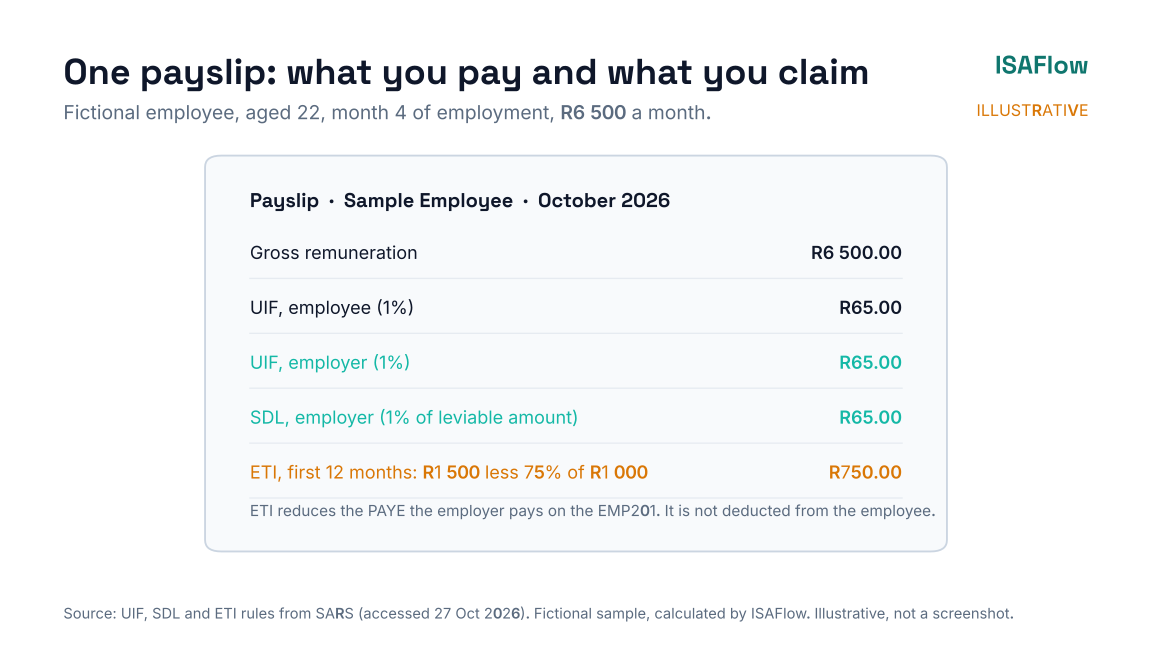
Illustrative, fictional sample. Not a screenshot.
After you pay, match the SARS payment on the bank statement. Our bank reconciliation routine covers it.
Where ISAFlow fits
ISAFlow's payroll engine calculates PAYE, UIF and SDL from versioned SARS tax tables, so when SARS changes a rate, the version that applies to each pay period is the one used.
ETI is calculated in payroll, and the EMP201 ISAFlow prepares covers PAYE, UIF and SDL with the ETI offset. ISAFlow prepares your EMP201, EMP501, IRP5/IT3(a) and VAT201 and exports the files for you to file on eFiling. You still check eligibility and file on eFiling yourself.
Start a free trial or contact us for a demo.
FAQ
What is the UIF ceiling in 2026?
R17 712 a month, or R212 544 a year. It has been at this level since 1 June 2021. The maximum monthly employee deduction is R177.12.
Do I pay SDL if I have only a few employees?
Only if total remuneration is expected to exceed R500 000 over the next 12 months, unless you're exempt.
How much is ETI per employee in 2026?
Up to R1 500 a month in the first 12 months and R750 in the second 12 months, depending on remuneration. It drops to nil at R7 500 a month.
Can I claim ETI for a domestic worker?
No. Domestic workers and connected persons are excluded.
When does ETI end?
The incentive is legislated to run until 28 February 2029.
Sources
All accessed 27 October 2026.
- SARS: Unemployment Insurance Fund
- SARS: Skills Development Levy
- SARS: Employment Tax Incentive
- SARS: Tax Statistics 2025
- Department of Employment and Labour: uFiling, how to declare and pay
- SAnews: SA official unemployment rate rises to 33.6%, 11 August 2026
- Department of Employment and Labour: National Minimum Wage increased to R30,23 per hour
This article is general information, not tax advice. Check your own position with a registered tax practitioner.