TL;DR
- A bank reconciliation proves that your books and your bank agree, line by line, at a date.
- Do it monthly at minimum, and weekly if you have volume. The longer you leave it, the harder each difference is to explain.
- Most differences are one of five things: timing, bank charges, duplicates, missing entries, or miscoded transactions.
- Close the bank before the EMP201 on the 7th and well before the VAT201 deadline. Every return downstream depends on it.
What a bank reconciliation is, and isn't
A bank reconciliation compares two records of the same money: the bank statement, which the bank keeps, and the bank account in your general ledger, which you keep. At the end of a period the two closing balances should agree, once you've accounted for items that are genuinely in transit.
It isn't a box-ticking exercise. It's the control that catches:
- supplier invoices captured twice,
- customer payments posted to the wrong debtor,
- debit orders nobody approved,
- cash that left the business without a document behind it.
And it's the foundation for everything SARS sees. Your VAT201 is built from transactions in your ledger. Your EMP201 payments have to be traceable to the bank. Your EMP501 reconciliation needs six months of SARS payments matched to declarations. None of that works if the bank isn't reconciled.
The routine
This works for a single business or one client of a bookkeeping practice. The steps don't change with size. The tooling does.
Step 1: Get a complete statement
Download the full statement for the period, not a screenshot of the app. Check the opening balance agrees with last month's closing balance. If it doesn't, stop. Something changed in a closed month.
Step 2: Bring every bank line into the books
For each line on the statement, there should be a matching entry in the ledger. Work through them:
- Customer receipts: match to the invoice they settle.
- Supplier payments: match to the supplier invoice.
- Payroll: match net pay to the payroll journal.
- SARS payments: match to the EMP201 or VAT201 they paid, using the PRN.
- Bank charges and interest: post them. They're real, and they're usually the first thing people forget.
- Debit orders: match to the agreement. If you can't, find out what it is.
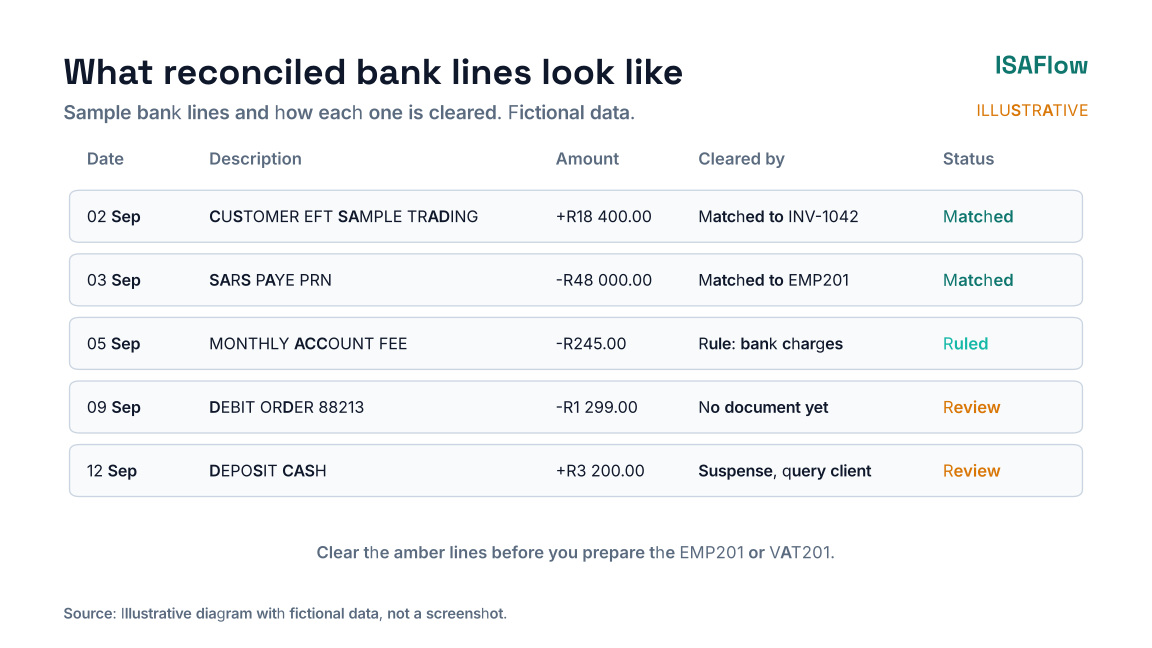
Illustrative, fictional data. Not a screenshot.
Step 3: Deal with what doesn't match
Five causes account for almost every difference:
| Difference | What it looks like | What to do |
|---|---|---|
| Timing | A payment you made on the 30th that clears on the 2nd | List it as an outstanding item. It should clear next month. |
| Bank charges and interest | Small amounts on the statement only | Post them to the right expense or income account. |
| Duplicates | The same supplier invoice captured twice | Reverse the duplicate. Find out how it happened. |
| Missing entries | A receipt or payment in the bank with no ledger entry | Find the document. Capture it. |
| Miscoding | The right amount in the wrong account | Correct the account. Check whether it affects VAT. |
Step 4: Use a suspense account sparingly
Sometimes you genuinely don't know what a deposit is. Post it to a suspense account so the bank balances, but treat that account as a to-do list, not a home. Anything older than a month needs an answer. A suspense account that grows every month is a sign the process is broken.
Step 5: Review and sign off
The reconciliation should show:
- closing balance per bank statement,
- plus or minus outstanding items,
- equals closing balance per ledger.
Someone other than the preparer should review it. In a practice, that's a reviewer. In a small business, it's the owner. Five minutes of a second pair of eyes catches most mistakes.
Step 6: Keep the evidence
SARS requires most records to be kept for five years from the date the return was submitted, and electronic records must be kept in a way SARS can access. Keeping them outside South Africa needs SARS's authorisation under section 30(2) of the Tax Administration Act (SARS record keeping). Store the statement, the reconciliation and the supporting documents together.
When to do it: build your month around SARS
The reconciliation is only useful if it's done before the returns that depend on it. Here's November 2026 as an example.
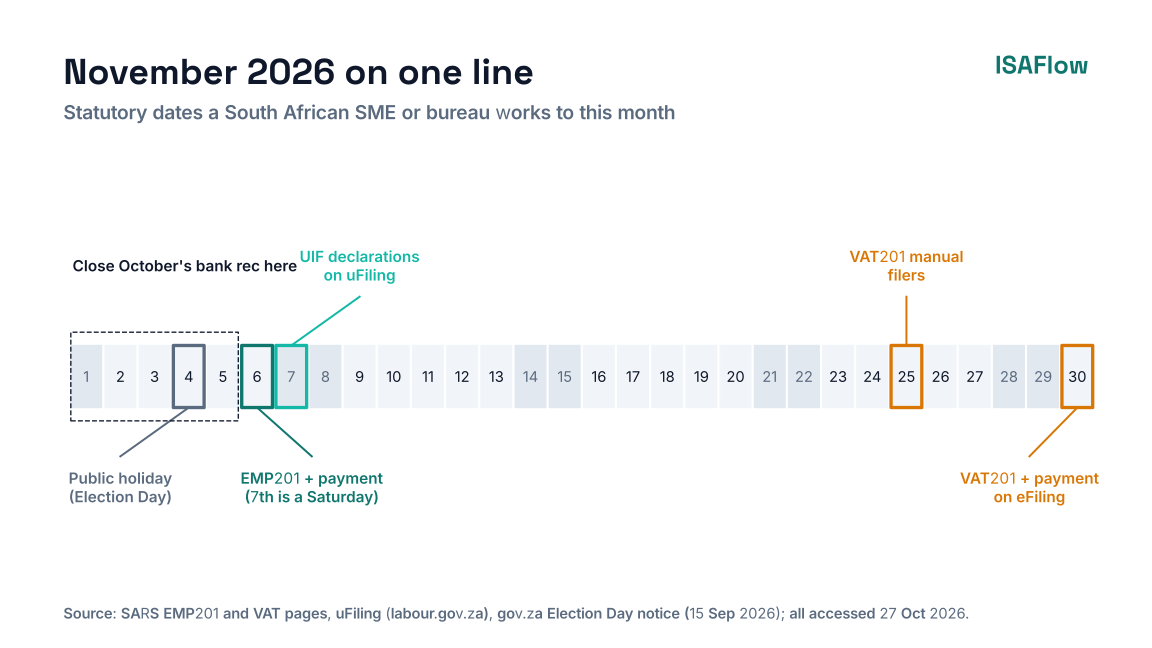
Dates from SARS, uFiling and gov.za. Chart by ISAFlow. Accessed 27 October 2026.
A few things stand out:
- The October EMP201 is due on Friday 6 November, because 7 November is a Saturday (SARS EMP201).
- Wednesday 4 November is a public holiday, Local Government Election Day (gov.za). That leaves fewer working days in the first week than usual.
- VAT for a Category B period ending 31 October is due on eFiling by Monday 30 November, the last business day of the month (SARS VAT).
So the October bank reconciliation should be closed in the first two or three working days of November. That's tight, which is the argument for reconciling weekly through the month and leaving only the last few days for month-end.
Make it lighter: weekly beats monthly
A monthly reconciliation of 400 lines takes a morning. Four weekly reconciliations of 100 lines each take less time in total, because:
- memories are fresh, so "what was this R2 300?" has an answer,
- missing documents can be chased while the supplier still remembers,
- errors don't compound into the next month.
If you upload your bank statement into your accounting software, the work becomes reviewing suggestions instead of typing. Rules do most of the categorising, and you check the exceptions. An AI assistant can help explain the odd lines too. Keep posting with a person unless the business has explicitly granted the AI connection posting permission. See AI in the books.
Five habits that keep it clean
- One bank account, one ledger account. Never mix two bank accounts in one ledger account.
- Never edit a closed month. If something changes, post an adjustment in the current month with a note.
- Write rules for recurring items. Rent, subscriptions, bank charges, salaries. Let the system handle the predictable lines.
- Attach the document. A matched transaction without a document is half a record.
- Reconcile every account. Credit cards, loan accounts and SARS accounts too, not just the main current account.
For bookkeeping practices
If you reconcile 40 clients' banks every month, the routine above doesn't change. What changes is how you organise it:
- a shared close calendar with every client's deadline,
- a status board so you can see which clients are reconciled, in review or stuck,
- preparers who own a portfolio and reviewers who sign off.
There's more on that in how to grow a bookkeeping and payroll bureau. If a client is still on desktop software, start with the migration plan.
Where ISAFlow fits
In ISAFlow, you upload your bank statement in CSV, OFX, QFX, QIF, MT940 or PDF. CSV and PDF statements from ABSA, FNB, Nedbank, Capitec and Standard Bank are detected automatically. ISAFlow then categorises the transactions with rules you set, with optional AI suggestions. Auto-match is one click. Document capture prepares a draft entry from a supplier invoice or receipt, which you check before it goes into the books. Each company's books are kept separate. Accounting practices get a bureau dashboard across all their clients, set up with you during onboarding.
Start a free trial or contact us for a demo.
FAQ
How often should a small business do a bank reconciliation?
At least monthly, before the EMP201 and VAT201 are prepared. Weekly is better if you have a lot of transactions.
What is an outstanding item in a bank reconciliation?
A transaction recorded in your books that hasn't cleared the bank yet, such as a payment made on the last day of the month. It should clear in the next period.
What should I do with a deposit I can't identify?
Post it to a suspense account so the bank balances, then find out what it is. Clear suspense items within a month.
How long must I keep bank statements in South Africa?
SARS generally requires records to be kept for five years from the date the relevant return was submitted.
Can I store my accounting records in the cloud outside South Africa?
Electronic records kept outside South Africa need SARS's authorisation under section 30(2) of the Tax Administration Act. Check where your provider hosts your data.
Sources
All accessed 27 October 2026.
- SARS: Record keeping
- SARS: Completing the monthly employer declaration (EMP201)
- SARS: Value-Added Tax
- Department of Employment and Labour: uFiling, how to declare and pay
- South African Government: Election Day declared a public holiday
This article is general information, not tax or accounting advice.