
TL;DR
- A typical payroll-and-VAT client generates about 32 SARS and UIF submissions a year. At 100 clients, that's 3 200 deadlines.
- You don't scale that by working harder. You scale it with one standard close, a deadline calendar across all clients, and approval workflows so nothing goes out unchecked.
- Anyone in your team who gives tax advice or completes returns for clients must be registered as a tax practitioner, or work under the direct supervision of someone who is.
- To your clients you're a POPIA operator. They need a written contract with you, and you need one with your software provider.
The maths of a bureau
Start with what a single client asks of you, if you run their payroll and their VAT and they file VAT every two months:
| Submission | Per year |
|---|---|
| EMP201 (monthly) | 12 |
| UIF declarations (monthly) | 12 |
| VAT201 (Category A or B) | 6 |
| EMP501 (interim and annual) | 2 |
| Total | 32 |
That's before provisional tax, annual financial statements, CIPC returns or anything else you do.
| Label | Statutory submissions a year, by number of clients |
|---|---|
| 10 clients | 320 |
| 50 clients | 1 600 |
| 100 clients | 3 200 |
| 200 clients | 6 400 |
Source: ISAFlow calculation from SARS and uFiling filing frequencies: 32 a year per client (12 EMP201, 12 UIF declarations, 6 VAT201, 2 EMP501). Assumes monthly payroll and bi-monthly VAT.
The deadlines also cluster. The EMP201 is due by the 7th for every payroll client (SARS tax calendar). The VAT201 is due by the last business day of the month after the period if you file and pay on eFiling (SARS VAT). Twice a year, the EMP501 lands on top (SARS tax calendar).
The market is big and steady
SARS had 648 500 registered PAYE employers at 31 March 2025, and 900 285 VAT vendors (SARS Tax Statistics 2025). Most of them are small, and many outsource.
| Label | Employers registered with SARS for PAYE, at 31 March |
|---|---|
| 2021 | 618 478 |
| 2022 | 632 599 |
| 2023 | 643 370 |
| 2024 | 643 948 |
| 2025 | 648 500 |
Source: SARS Tax Statistics 2025. Accessed 27 October 2026.
The work isn't going away. The question is whether you can take on more of it with the same team.
1. Standardise the close
Every client should follow the same monthly close, in the same order. That's the single biggest lever.
A standard monthly close might be:
- Inputs in by day X. Payroll changes, supplier invoices, bank statements. Publish the date to clients.
- Bank reconciled using the month-end bank reconciliation routine.
- Payroll run and reconciled to the ledger.
- EMP201 prepared, reviewed and submitted.
- VAT reviewed in VAT months.
- Management pack sent.
Write it down. A checklist that lives in someone's head can't be delegated, and it walks out the door when they do.
Standardise the chart of accounts too
If every client has a different chart of accounts, every review starts from scratch. Use a standard chart with a small number of client-specific accounts. Reviewers learn where to look, and bank rules can be reused across clients.
2. Run one deadline calendar for every client
You need to see, on one screen, every client and every deadline: who's done, who's in review, who's stuck waiting for documents.
The columns are simple:
- client,
- obligation (EMP201, VAT201, EMP501 and so on),
- period,
- due date,
- preparer,
- reviewer,
- status.
Sort by due date. Everything due this week that isn't "submitted" is your morning stand-up.
3. Split preparer and reviewer
The person who prepares a return shouldn't be the only one who checks it. A two-step workflow catches errors and builds capacity, because:
- preparers can be junior and work through volume,
- reviewers focus on exceptions, judgement and sign-off,
- clients get a consistent standard whoever is on leave.
Track review findings. If the same error keeps coming back from one preparer, that's a training conversation. If it comes from every preparer, the checklist is wrong.
4. Get the compliance basics right
Tax practitioner registration
Under section 240 of the Tax Administration Act, every natural person who gives advice on a tax Act, or completes or helps complete a return for someone else, must:
- register with or fall under a recognised controlling body, and
- register with SARS as a tax practitioner,
within 21 business days of first doing that work. Section 240(2) sets out exceptions. One covers a person who gives the advice or completes or helps complete a return solely under the direct supervision of a registered tax practitioner (SARS FAQ on exemptions). Check your team's status, especially for new hires.
POPIA: you're an operator
Your clients are responsible parties for their employees' and customers' personal information. When you process it for them, you're an operator. Under POPIA, section 21 requires a written contract between them and you that ensures you apply the security safeguards in section 19, and you must notify the client immediately if you suspect personal information has been accessed by an unauthorised person.
In practice that means:
- an engagement letter or data processing agreement with every client,
- access controls, so staff only see the clients they work on,
- a breach procedure you've actually tested,
- the same checks on your own software provider.
5. Make the software do the predictable work
The point of software in a bureau isn't to replace judgement. It's to remove the work that doesn't need judgement:
- Bank rules for recurring lines, reused across clients.
- Matching that suggests the obvious pairs and leaves only exceptions.
- Document capture that turns a supplier invoice into a draft entry for a person to check.
- Payroll calculated from current tax tables, so nobody updates rates by hand.
- Separate books per client, so nothing leaks between companies.
- Approval workflows, so nothing goes out without a second check.
If you're moving clients off desktop software first, see the desktop to cloud migration plan. If you're weighing AI assistants, read how MCP lets assistants work in your accounting safely.
6. Measure what matters
Three numbers tell you whether you're scaling:
- Clients per preparer. It should rise over time without errors rising.
- Days from inputs received to submission. Shorter means less deadline stress.
- Review rework rate. The share of returns that bounce back from review.
If clients per preparer rises and rework rises with it, you're stretching, not scaling.
Where ISAFlow fits
Each company's books are kept separate. Accounting practices get a bureau dashboard across all their clients, set up with you during onboarding. Once it's set up, the bureau owner links your client companies, and the dashboard shows them in one view. The practice module covers clients, jobs, tasks, time and WIP. A compliance calendar tracks VAT, EMP201, EMP501, IRP6 and CIPC due dates. Any company, including a trial company, can switch it on under Company settings, Compliance (owner, admin or manager role).
Approval workflows put a second person on the changes that matter. Roles (owner, admin, manager and viewer) control who can change what, and only an owner can make someone else an owner.
ISAFlow's payroll engine calculates PAYE, UIF and SDL from versioned SARS tax tables. Bank transactions are categorised by rules, with optional AI suggestions, auto-match is one click, and document capture prepares a draft entry.
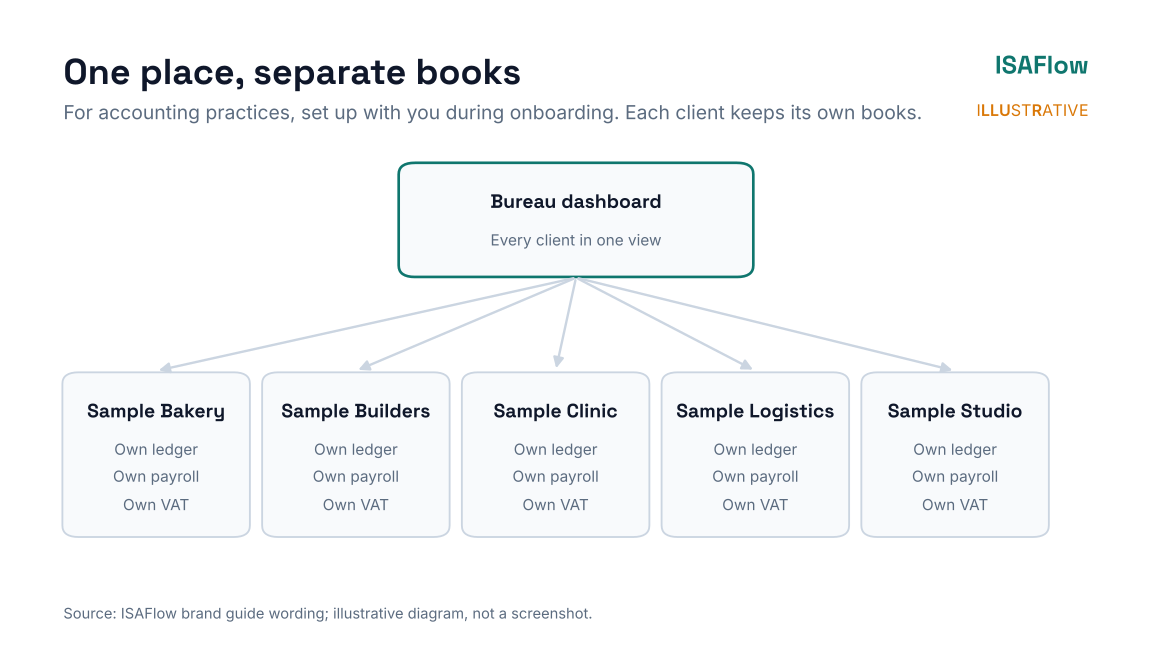
Illustrative diagram, not a screenshot.
ISAFlow prepares your EMP201, EMP501, IRP5/IT3(a) and VAT201 and exports the files for you to file on eFiling. Filing stays with you on eFiling.
To set ISAFlow up for your practice, including the bureau dashboard, contact us for a demo. To try ISAFlow on one company first, start a free trial.
FAQ
How many clients can one payroll administrator handle?
It depends on payroll complexity, employee numbers and how standardised your process is. Measure clients per preparer and review rework, and grow the first without the second.
Do bookkeepers need to register as tax practitioners in South Africa?
Anyone who gives advice on a tax Act or completes returns for others must register with a recognised controlling body and with SARS, unless an exception applies, such as doing the work solely under the direct supervision of a registered tax practitioner.
What does POPIA mean for a payroll bureau?
You're an operator for your clients. You need a written contract with each client and must apply appropriate security safeguards and report breaches.
How many SARS submissions does a payroll client need each year?
A client with monthly payroll and bi-monthly VAT needs about 32: 12 EMP201s, 12 UIF declarations, 6 VAT201s and 2 EMP501s.
Sources
All accessed 27 October 2026.
- SARS: Tax Statistics 2025
- SARS: Does the TAAct exempt any person from registering as a tax practitioner?
- SARS: When must tax practitioners register with a recognised controlling body?
- SARS: Tax calendar and Value-Added Tax
- SARS: Tax periods for VAT vendors
- Department of Employment and Labour: uFiling, how to declare and pay
- South African Government: Protection of Personal Information Act 4 of 2013
This article is general information, not tax, legal or accounting advice.